France · Engagement proposal · September 2026
Flawverce Services et Logistique, Paris, for Wild Rice World. Where your product already fits, where the demand sits, what the pack still needs, and the answers that unlock the first order. How we work together is still open.
01 / The shelf
One price comparison, on one pack size: 250 g, the size of your own doypack. Nothing here asks you to convert anything while reading. Where a competitor sells another size, the figure is a calculation and says so.
Finished cooking sauces, curry and Pad Thai alike. Face prices read on the retailer's own page in August 2026, brand by brand, whole range. Two of these fifteen are read on a real 250 g pack. The other thirteen are that same observed price brought back to 250 g, and every row says which it is.
Only Blue Elephant's panaeng sits within a quarter of a euro of your curry. Above it, the two twins. Below it, five French brands with no Asian specialism. And premium in Thai food does not pay beyond one and a half times: the same Giraudet 250 g pack moves from 3.59 € at Carrefour to 5.35 € on Giraudet's own site, up 49 percent.
Prefer euros per kilo? Multiply any figure by four. Every per-kilo price, its retailer link and its verification status is in the sources. Four Pad Thai sauces sold by volume, Suzi Wan 143 ml, Real Thai 180 ml, Autour du Riz 200 ml and Exotic Food 250 ml, are off this scale on purpose: placing them on it would mean assuming a density. They are in the formats block below.
A different question from price, so a separate block. A pack size is not a measurement, it is a door: each one below carries the channel it actually serves. The French retail shelf first, in grams, then the three bulk sizes that decide everything past it.
Sold by volume rather than by weight, so kept off the price scale: Suzi Wan Pad Thai 143 ml, Real Thai Pad Thai 180 ml, Autour du Riz Pad Thai 200 ml, Exotic Food Pad Thai 250 ml, deSIAM's six dipping sauces 250 ml each. These bottles answer to their own aisle rather than to yours: Suzi Wan and Real Thai sit in mainstream supermarkets, Exotic Food in Asian grocery online, and no channel is on file for Autour du Riz. Tanoshi's 300 ml curry is the one exception on weight: the original survey priced it as 300 g, and it is carried forward that way rather than corrected silently. Curry pastes, a different product entirely, run 50 to 400 g.
Two things this scale does not tell you. Meal kits, the slowest of the seven segments, have no size on it: their sauce mostly arrives as a sachet from a co-packer, so the pack that serves them would be the co-packer's rather than yours, and nothing in the study fixes a contenance to that segment. And a 50 g sachet is costed for hotel amenities, room-service trays and trade-show sampling, but that is a sampling tool rather than a channel, so it stays off a scale about distribution.
Coverage only, no prices: who sells what, checked as a whole range rather than by the flavour that happens to share a name with yours. Twelve brands, three categories.
Coverage, not price: prices live in the 250 g scale above and the 100 g chili-crisp scale below, nowhere else. Namprik is the one case where the French shelf has no occupant at all, at any price, from any brand. Your Mushroom Soy Sauce has three known competitors and zero confirmed French prices, so it is not shown rather than estimated. Real Thai's curry is the one mid-market sauce genuinely coconut-forward, 44 percent as first ingredient, with vegetables already in the jar.
How we checked it. 189 product pages read in the original August 2026 pass, more added since to complete each brand's range. Every price is a face price, read straight off the retailer's own page. Every product was checked ingredient by ingredient, to rule out a paste, a kit, or a ready meal with everything already cooked in.
Your own range does two different jobs. Green Curry, Panang Red Curry and Pad Thai are cooking sauces: you add raw protein and vegetables, then cook. Namprik Original, Namprik Tom Yum and Namprik Sriracha are condiments: no coconut milk, no cooking, spooned on after the dish is made. Mushroom Soy Sauce stands on its own. Super Pack bundles the others.
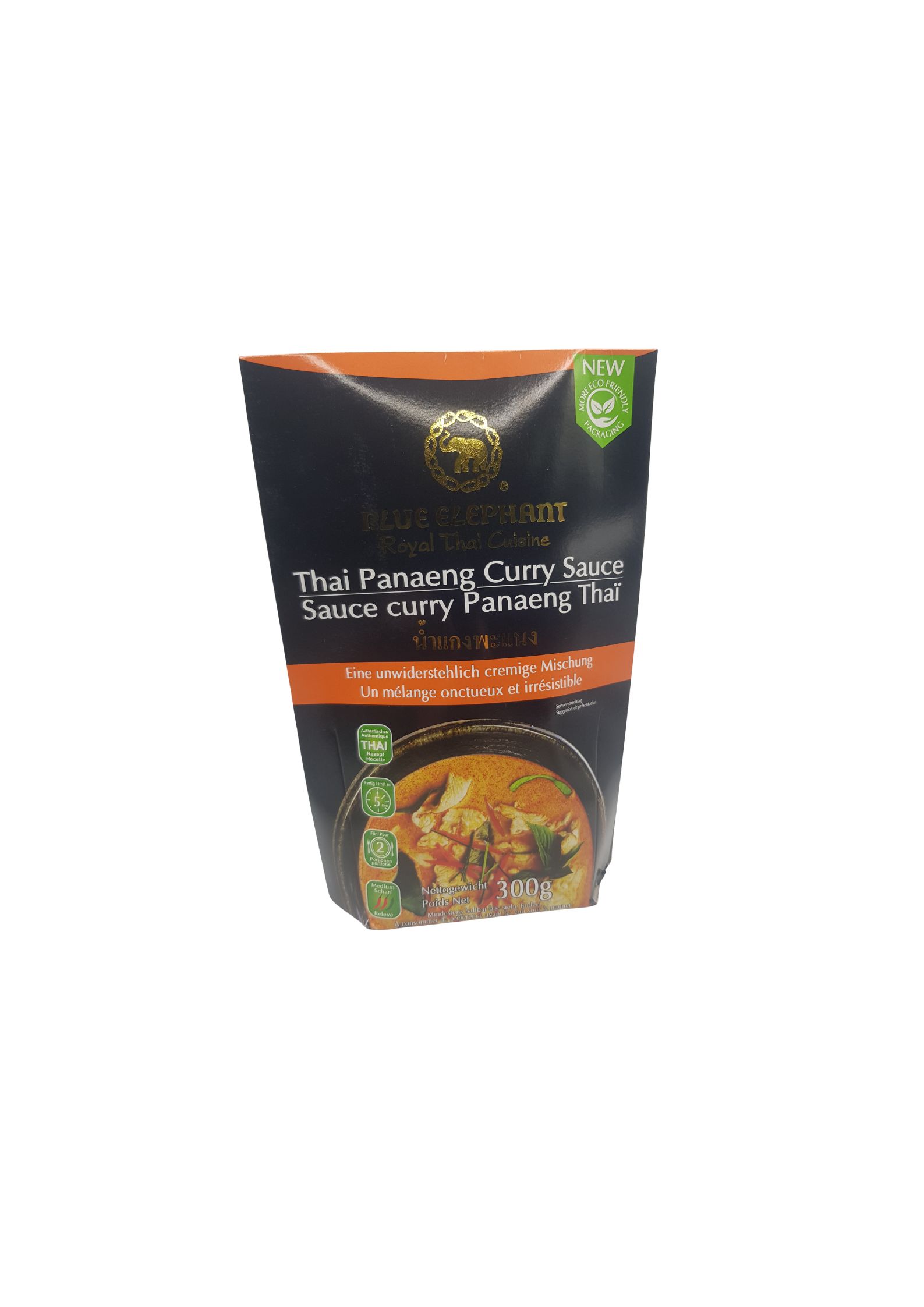
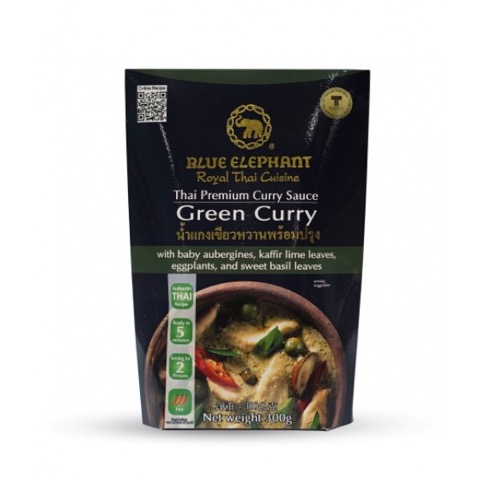
Blue Elephant. Four curry sauces, three out of stock at Iberco, their exclusive French distributor. No standalone Pad Thai sauce, only a 300 g cooking set with noodles, excluded as a kit. A Pad Krapow stir-fry sauce, a sweet-and-sour, a lemongrass dressing, a plum sauce and a 70 g Tom Yam paste do not compete in either of your categories. Their finished 250 g Tom Yam Soup sells only outside France, and a soup is the meal itself. No chili-crisp anywhere in the catalogue.
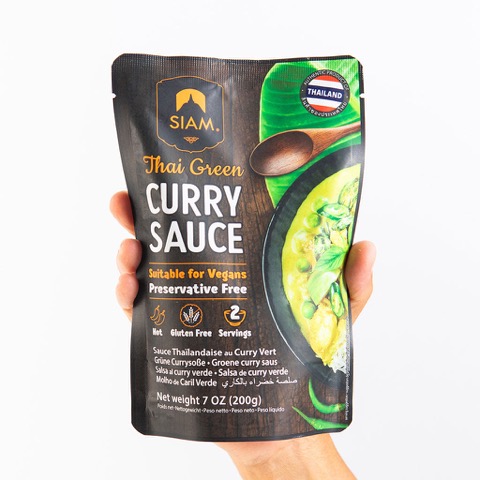
deSIAM. Three curry sauces, all 200 g, all 5.40 €, all stating "serves two, ready in about 10 minutes", the closest match to your curry line format for format. Pad Thai 100 g at 4.00 €. Six 250 ml dipping sauces and four 70 g pastes are excluded: a dip served alongside is a different format from a sauce a raw protein cooks in. No chili-crisp.
Suzi Wan. Broadest range, least coconut-forward. Its 400 g curry sauce is 2.8 percent coconut, fifth or sixth ingredient behind water, tomato and onion. Tomato-based, not a twin. Pad Thai 143 ml at 2.42 € at Houra, confirmed delisted from Carrefour as of 27 August 2026.
Cock Brand and Exotic Food. Paste only on curry, the same distinction that excludes Mae Ploy and Aroy-D. Exotic Food's satay sauce is brushed on cooked protein, a different format. Both confirmed absent on chili-crisp, not merely unfound.
Real Thai. The most genuinely coconut-forward of the mid-market five, 44 percent coconut milk as first ingredient, at Auchan, Carrefour and Cora. One real difference: the jars already carry their own vegetables, roughly a third of the jar, so a cook only adds protein. No live price could be captured at any of the three retailers.
Autour du Riz. A wide range of Asian condiments, tamari, teriyaki, ponzu, gochujang and more. Not one coconut-based curry sauce anywhere in it.
Confirmed on sale, no live price captured. Thai Kitchen, Thai Expert / T&T Foods (paste only), Mei Asia, Ayam. None is guessed at. A Wagamama-branded curry sighting at Bienmanger is out of stock at 10 percent coconut cream, too thin to count as a twin, so it is flagged rather than benchmarked.
Excluded, and why. Mae Ploy and Aroy-D sell no finished sauce in France, only paste. No private-label Pad Thai sauce was found at Carrefour, Auchan or Casino, unlike curry where all three carry one. Blue Dragon has no confirmed French retailer. Ready meals under the Pad Thai name already have noodles, vegetables and protein cooked in.
On chili-crisp. Lao Gan Ma 210 g at 4.90 €. Hariba 110 g at 8.00 €, handmade in Rennes. White Mausu 240 g Peanut Rāyu at 9.50 €, Irish, confirmed at four French retailers. Fly By Jing 170 g at 21.99 €, a US import through a German mail-order importer inactive at the time of this check. Priced in line with each tier, a 100 g namprik jar would sell near 2.33 €, 3.96 €, 7.27 € and 12.94 € respectively. Even the low end already clears your own UK retail price of GBP 5.50 to 6.95.
Excluded on chili-crisp. Trader Joe's has no French distribution. S&B La-Yu is a thin liquid chilli oil, not a crunchy relish. Nam Prik Pao, sold at Carrefour at 3.99 € for 114 g, is a spreadable paste built around shrimp paste, stirred into a base rather than shaken onto a finished dish, so it is excluded on texture, not price. Its price lands almost exactly where your trade price does. Four sellers of a crispy Thai shallot namprik were found, all shipping from the UK only.

Blue Elephant and deSIAM are the only two brands selling your exact format in France: a doypack, coconut milk first, nothing to dilute. Everything else on the finished Thai sauce shelf is a French brand with no Asian specialism.

Blue Elephant
Panaeng curry, coconut 57.7%, 300 g
4.69 € · 250 g equivalent, calculated
300 g pack at 5.63 €

Blue Elephant
Green curry, coconut 60.8%, 300 g
5.23 € · 250 g equivalent, calculated
300 g pack at 6.27 €
Out of stock at Iberco

deSIAM
Green curry, coconut 64%, serves two, 200 g
6.75 € · 250 g equivalent, calculated
200 g pack at 5.40 €

Wild Rice
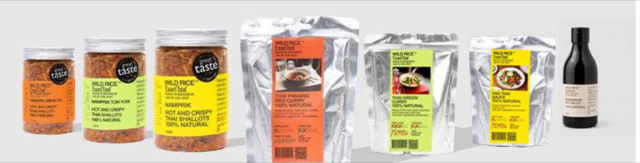
Curry, 250 g, two portions
4.46 € · real 250 g pack, trade
No conversion needed

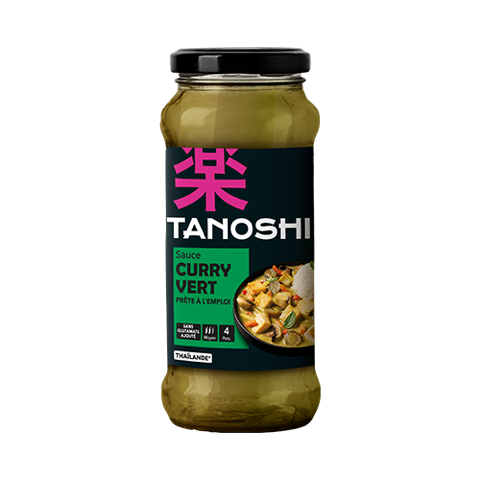
Tanoshi
Green and red Thai curry, 300 ml
3.46 € · 250 g equivalent, calculated
300 ml pack at 4.15 €

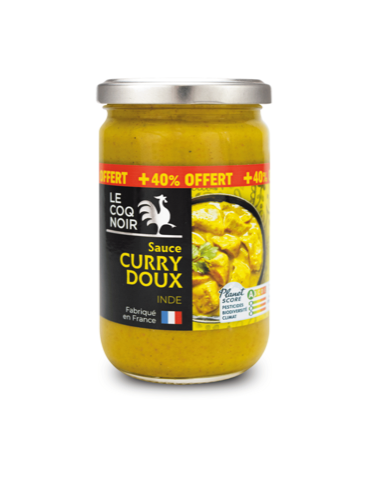
Le Coq Noir
Mild curry, organic, 260 g
3.55 € · 250 g equivalent, calculated
260 g pack at 3.69 €

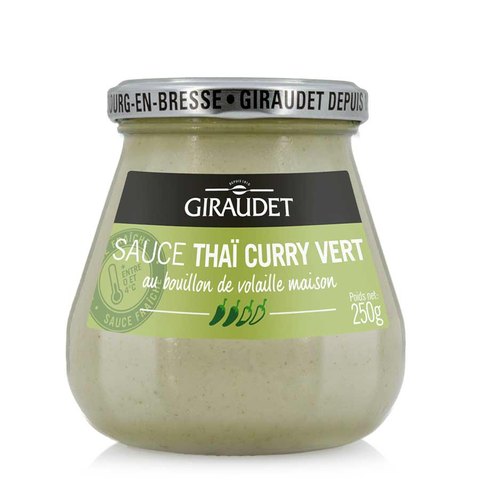
Giraudet
Thai green curry, 250 g
3.59 € · real 250 g pack, observed
5.35 € on the brand's own site

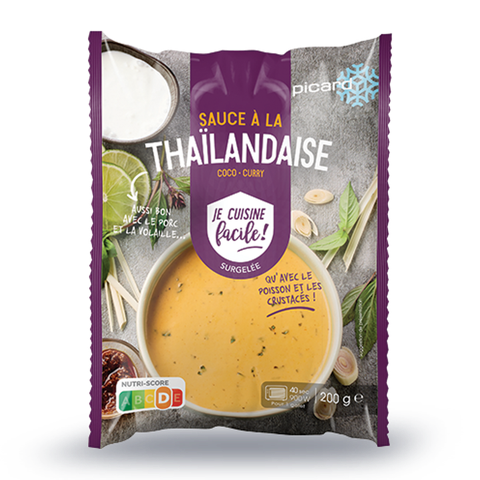
Picard
Thai curry coconut, frozen, 200 g
3.74 € · 250 g equivalent, calculated
200 g pack at 2.99 €
Every figure in bold is the same 250 g basis as the scale above. Also checked, in the detail above: Omie and Terra Sana on the organic side, Patak's and Sharwood's on the adjacent Indian shelf, where France already pays 5.36 to 5.84 € per 250 g for a sauce carrying only 4 to 6 percent coconut.
The shelf, one pack at a time
The same fifteen products the scale above prices, here as real packs rather than rows. Every photograph is the retailer's or the brand's own shot of the actual pack, cut out of its studio background and nothing else. What you cannot see below is not shown: where a field says not documented, we did not find it, and we have not guessed it.
06 15
Drag or use arrows
Wild Rice
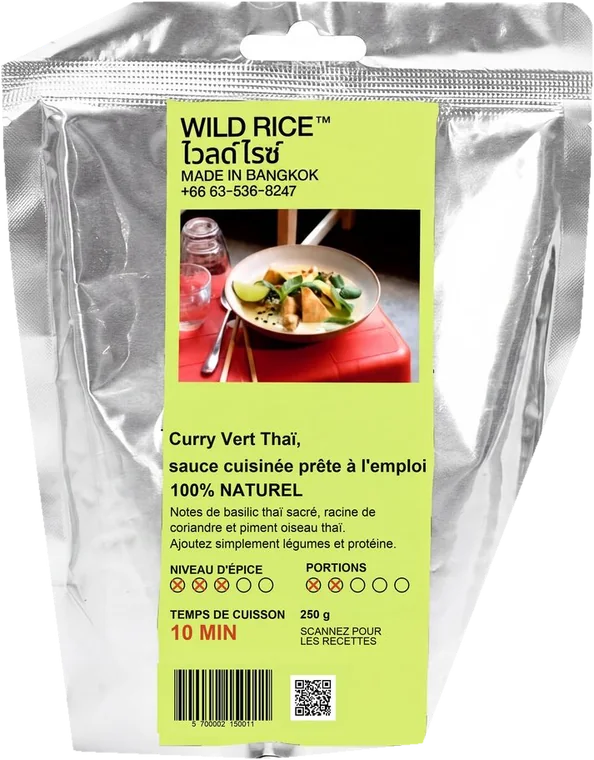
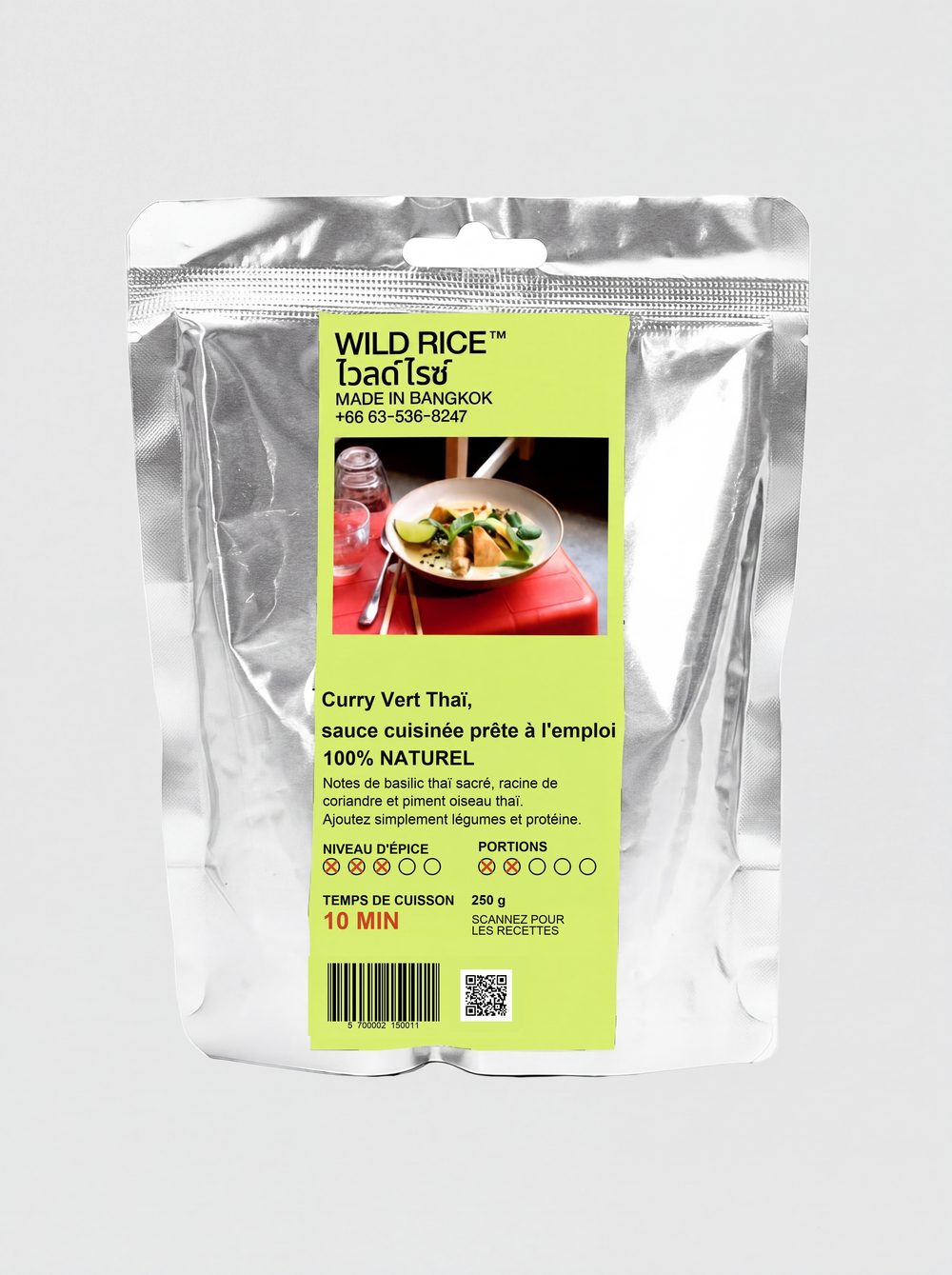
A finished Thai cooking sauce with the coconut milk already in it. Two portions, ten minutes, add your own protein and vegetables. Retort aluminium doypack, made in Thailand.
The only brand on this board selling all three categories. And no shrimp paste or fish sauce opens the weekly vegetarian menu that French school and company canteens are required to serve. Nobody on this shelf is using that.
4.46 € sits close to cost, leaving little for an importer, a wholesaler and a retailer to each take a margin from.
No brand on this shelf builds a 250 g pack around a dinner for two where the cook adds their own protein. That is the claim this pack was made for.
Prices are the same 250 g basis as the scale above, and each fiche says whether the figure was observed on a real 250 g pack or calculated from another size. Ingredient lists are documented for two packs only, Wild Rice and Blue Elephant panaeng; every other pack says so rather than filling the gap. All sources cited.
A different aisle, so a separate block with its own single basis: the 100 g jar, the size of your own namprik. Nobody sells chili-crisp in a 250 g pouch, so putting it on the scale above would be meaningless. Same method: observed shelf prices, brought back to one size.
Four tiers, and your trade price sits just above the Chinese mass-market floor. The three prices above it are Irish, French and American, not Thai: no specialist ceiling to bump into.

02 / The demand
Not three segments, seven. Each one profiled with a named decision-maker and a real entry point where the research found one, and said plainly where it did not.
Only locations the dossier actually establishes are plotted. Nineteen of the named companies have no stated French location on file, including every name in company canteens, so they are absent from the map rather than guessed at. Base map: gregoiredavid/france-geojson, regions, simplified, open licence. ProKitchens self-declares four cities, Paris, Lyon, Lille and Marseille; the 13 August registry pass found Lille and Marseille announced but not registered at that time, so Lille is marked as self-declared here.
Nobody has moved past qualification yet, so this is the order to work them in, not a stage anyone has reached.
Buys the product exactly as it is today: no new format, no certification. An independent decides in weeks, a department store waits for a range review. One wholesaler alone reaches about 2,000 independent shops.
The most advanced column. Opens on namprik, not curry: it drops into their existing crunchy-topping slot with no recipe change. Jour and Spok carry a curry fit on top, through the hot bowl each already runs.
Ranked by barrier, not network size. Tao Bento leads on a named buyer despite being much smaller. Pitaya trails despite the biggest network: no supplier door was found behind it.
6.7 million meals a day among SNRC members alone. Two of these six have a named, LinkedIn-confirmed buyer. Their weekly menu is the most frequent listing window in the pipeline.
French hotels must feed their staff by law: one guaranteed minimum per meal, 4.35 € from 1 June 2026. The buyer is the staff-canteen economat, not the chef. The lowest barrier is a central buying group's supplier form, not the two most recognisable names.
The biggest outlet, and the slowest. Sauces mostly arrive as sachets from a co-packer, so the real counterpart is the co-packer, not the brand. Kitchen Trotter is the exception: it buys branded ingredients as they are. Les Commis is the second fast door.
Three real matches, not five. ProKitchens is the only true neutral aggregator: a landlord renting space to brands it does not own. Taster owns its seven brands; Clone licenses concepts to over a thousand independent kitchens. A fourth and fifth were searched for and not found: the market is this narrow in France today.
Two more names from the original ten sit outside this pipeline for now: one is in receivership, monitored rather than pursued; the other could not be verified as an operating company under any spelling checked.
03 / The pack
Checked directly against your current pack, Green Curry, Panang Red Curry and Namprik Sriracha, against French requirements. Nothing here is a guess about your artwork.
English only today. France requires a full French translation of the whole label. Reg. 1169/2011, Art. 15
States Sodium, 0.834 g and 0.684 g per 100 g. Must state Salt instead: sodium × 2.5, so about 2.1 g and 1.7 g. Reg. 1169/2011, Art. 30
Plain text today. They need bold or equivalent typeset inside the ingredient list. Reg. 1169/2011, Art. 21
Wild Rice Ltd, London only, which is a third country since Brexit. Needs the French entity's own name and address, once it exists. Reg. 1169/2011, Art. 8
Absent. Triman plus info-tri, mandatory since January 2022. Loi AGEC, Art. 17
Complete and accurate. Nothing missing. Reg. 1169/2011, Art. 18
Present and complete. Nothing missing. Reg. 1169/2011, Art. 9
Absent, and voluntary. Worth treating as a sales lever rather than a gap: free to register, about six minutes online. Voluntary, process below
Not a legal requirement, and not something we can answer from France. It unlocks structured wholesale, hotel groups and collective catering. Private scheme, separate from the label. Question 4 below
The full gap list, sourced line by line


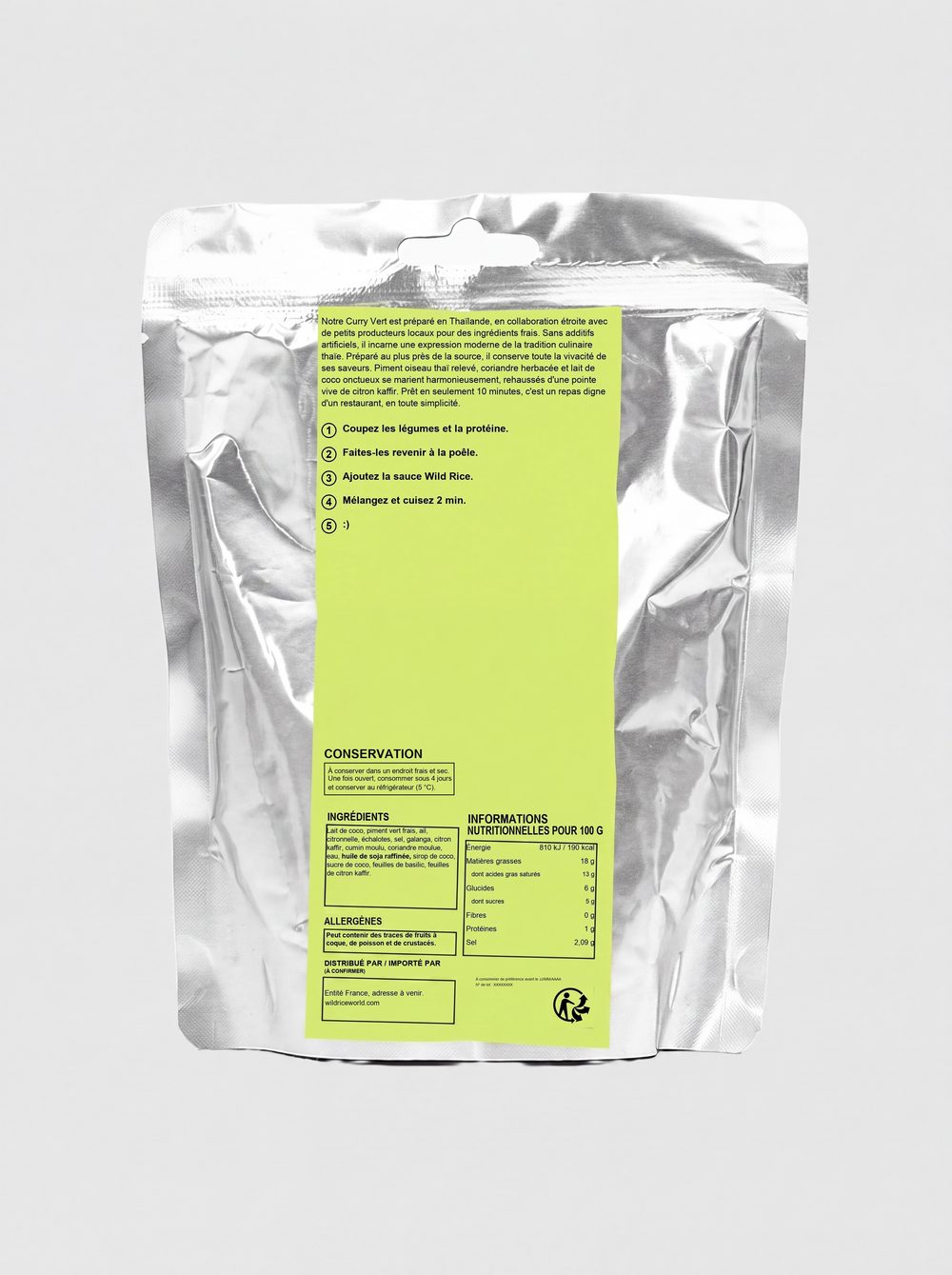
Built from the real Wild Rice UK pouch. French text, Salt instead of Sodium, allergens in bold, Triman, spice level, portions and cooking time, all composited on top of the genuine pack and its real barcode. No AI-generated imagery: this is your actual label, edited.
Your current barcode is Danish, not Thai, which means a European circuit already exists. Whether the French entity buys through it or imports directly changes what is printed on the pouch. This is question 1 below, and it is the one that unblocks the others.
Scenario A
It becomes the importer into the Union, with the obligations that carries.
Scenario B
Already in free circulation before they reach France.
Either way, the French pack is a separate reference and needs its own barcode. The scenario decides who registers it: a new GTIN under your GS1 registration, or the French entity taking out its own GS1 France membership, which carries an annual cost to budget for. Retailers will not list a reference whose barcode is not registered to the company selling it.
How it works. Free to register with Santé publique France, about six minutes online, no fee. Governed by a seven-country steering committee: France, Belgium, Germany, Luxembourg, Netherlands, Spain, Switzerland. You calculate your own score from the official algorithm, not Santé publique France, using energy, saturated fat, sugars, sodium, fibre, protein and fruit, vegetable, legume and nut content per 100 g. Logo files and the graphic charter arrive by email on registration. France has run the newer V2 algorithm since 16 March 2025, so registering today means calculating directly under it.
Where it would likely land, and this is not an official calculation. Green Curry carries 13 g saturated fat per 100 g, Panang 14 g. A directly comparable product already on the market, The Spice Tailor's Keralan Coconut Curry, carries 15 g and scores Nutri-Score D. Same range, so C or D is the plausible territory, driven by the coconut milk. Not a confirmed letter: the fruit, vegetable, legume and nut input is not on the pack, and only Wild Rice running its own recipe through the official calculator can produce a printable number.
What is actually documented on sales impact. Brands using the logo cover an estimated 63% of French food sales volume, with 1,500+ companies registered as of January 2026. That is a sign of shelf normalisation, not a proven per-product uplift. No study quantifies a specific sales increase from adding the logo to one product. Calling it a sales booster on fine-grocery shelves is a market read, not a published statistic.
04 / The plan
Nothing is settled. Below is what is already moving, what it leads to, and the two approaches open to us. The terms follow the approach you pick, not the other way round.
Now
Two ways of working together are on the table. Nothing is decided.
In parallel
Five workstreams. Tap one to open it.
The written terms of the partnership itself: how the French entity and Wild Rice work together, roles, and duration, as the entity takes shape.
To be discussed, not decided. The intent is for it to become Wild Rice's official and exclusive distributor in France, not yet formalised in writing. One point stays open: either Wild Rice's two founders also become associates alongside Mai and Walid, or the entity stands on its own, held by Mai and Walid, with a distribution agreement linking it to Wild Rice.
Send us everything you hold: technical files, label artwork, test reports, and the certificates themselves. We audit them on our side and check them against what France actually requires. The label gaps set out in section 03 above are the starting point of that compliance path, not the finished list. See the pack.
Still to be set and selected, alongside the storage depot. The criteria come first: coverage, cold chain if needed, and the segments in section 02 the partner has to be able to serve.
Two commercial agents already active, commission only, no salary, being built into a fully onboarded team managing a live pipeline.
Running throughout, from day one
Outside of this. Buyer negotiation and closing, stock, logistics and transport, label compliance and listing fees are not part of what Walid and Mai are directly driving.
Flawverce proposes to build Wild Rice France's future public-facing online store, with payment built in. A different site from this one, which stays the working document for the deal itself.
2,600 € to build 500 € a month maintenance
A Flawverce proposal, quoted on its own. It stands apart from whichever approach we settle on, and nothing here depends on it.
Option one
Four associates: Mai, Walid, and Wild Rice's two founders.
Option two
With exclusivity intended once formalised.
Regional partners get appointed across France either way. Nothing is exclusive until signed.
05 / What we need from you
Answer them and send them back. A line or two each is enough.
Drive access
One name and email address per person, one per line.
Nothing needs to be perfect or final.
A shared workspace is open. , one email per person, usually granted within the hour. This is where documentation will live going forward, for the French team and the branch structuring. Drop what you have there as you go, not just for this list.
Reply with what you can on the questions and the price sheet. Send what you already have, the rest can follow.
Sharing documents as you go? Request access to the shared Drive.